Exploring Metabolic Intelligence Through Contextual Data
Align is a metabolic intelligence platform I developed during a 4-week AI coding bootcamp. The project explored a simple question: What if people with type 1 diabetes could better understand how daily habits impact blood glucose without manually piecing together data across multiple apps?
- Role
- UX Designer · AI Product Builder
- Responsibilities
- Product Strategy · UX/UI Design · Systems Thinking · AI Workflow Design
- Tools
- Cursor · Claude · Vercel · Prisma · Clerk · Figma
The Problem
People with type 1 diabetes rely on data every day, but many of the factors influencing glucose live across disconnected platforms:
Blood Glucose → Dexcom, Eversense, FreeStyle Libre · Workouts → Strava, Runna · Biometrics → Apple Health, Oura, Garmin, Fitbit · Nutrition → MyFitnessPal · Menstrual Cycle → Clue, Flo
A question that frequently came up in conversations within the diabetes community was: If these systems are already so smart and predictive, why can’t they learn from all of my other data too?
Many diabetes products are limited by regulatory and safety considerations, making deeper interpretation and cross-platform recommendations difficult to implement responsibly at scale.
The Opportunity
Before this project, I assumed this was a problem only large healthcare companies or research teams could solve. That changed when I joined Build After Dark, a 4-week AI bootcamp focused on AI-native product development. Suddenly, the idea felt approachable.
Rather than building a medical recommendation engine, I wanted to explore contextual understanding: How do workouts, movement, and routines impact glucose? What patterns emerge over time? How can those relationships be surfaced more clearly? How can we reduce the cognitive load of manually piecing this together?
These questions became the foundation for Align.
Defining the MVP
One of the biggest early challenges was scope. My initial vision included predictive alerts, location-aware insights, and multi-source health analysis. But AI tools made it easy to overbuild before validating the core experience.
After several iterations, I narrowed the MVP to integrations I personally used and could realistically access.
MVP Integrations
- 01
Blood Glucose Data
Integrated real-time CGM data through the Dexcom Share API to power timeline visualizations and pattern analysis.
- 02
Workout Data
Connected Strava activity sessions to identify glucose responses around workouts and exercise intensity.
- 03
Movement Data
Ingested hourly step count data from Apple Health to surface movement trends and daily activity correlations.
User Flow
- Open Align
- Connect Data (Dexcom · Strava · Apple Health)
- Set Preferences
- View Timeline
- Analyze Patterns (7d · 30d · 90d)
- Generate Insights
- Review Insights
- Build Awareness
Product Thinking in an AI Workflow
One of the biggest lessons from the project was realizing that AI-assisted development still requires strong product structure and systems thinking.
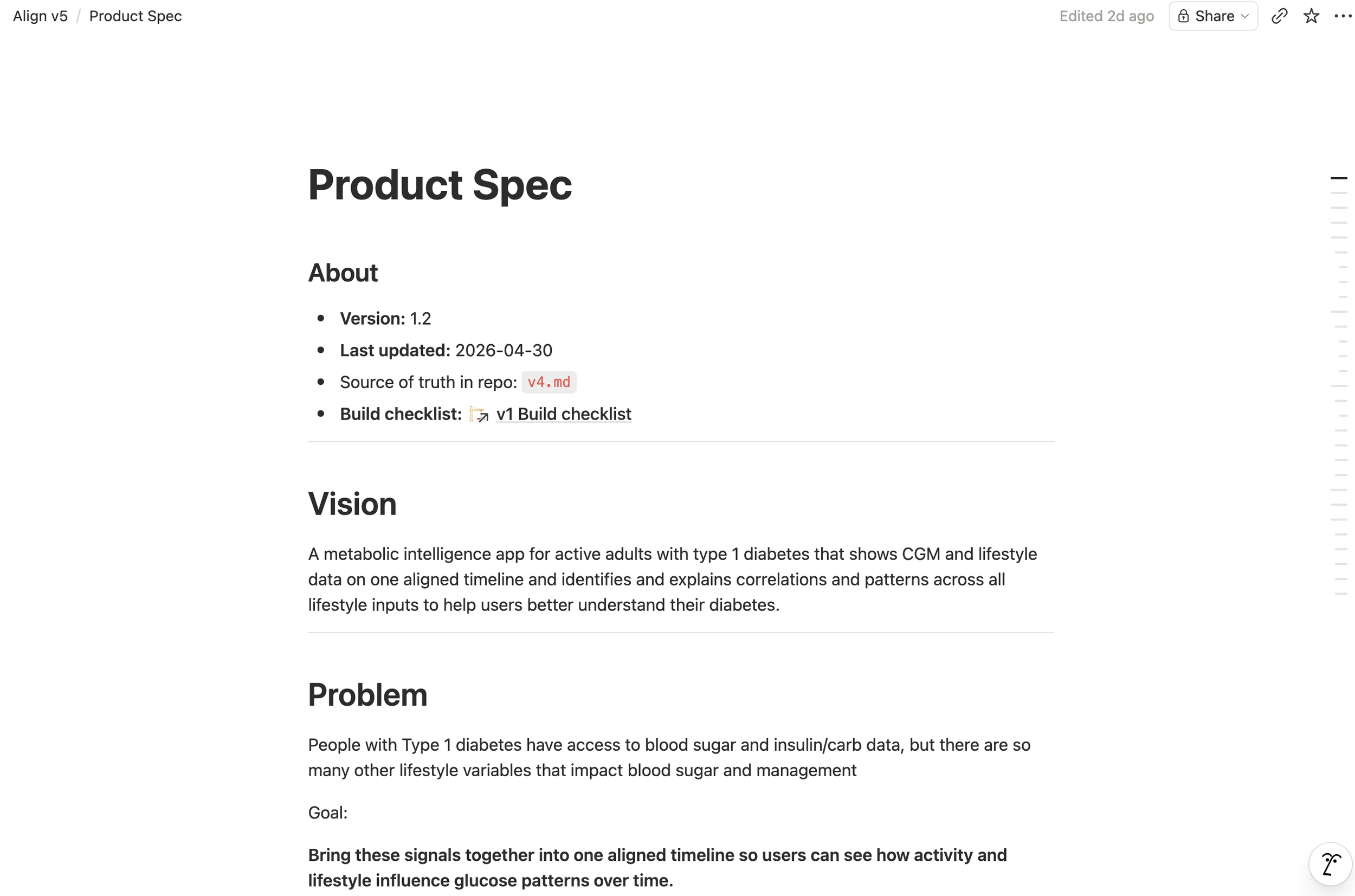
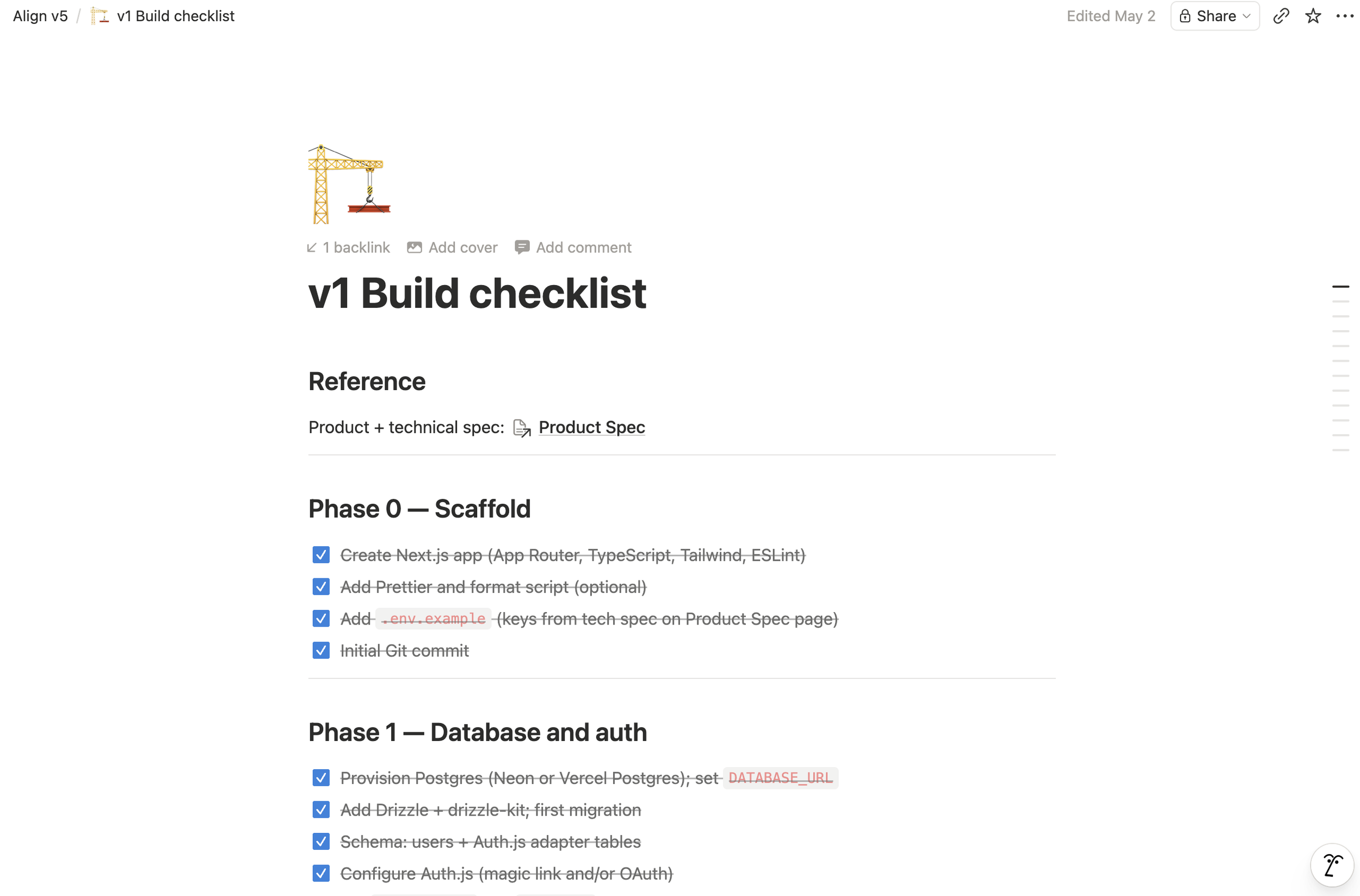
My first several versions were visually functional, but difficult to debug or extend because I relied too heavily on AI-generated output without defining the underlying architecture first. By version five, I shifted to a more structured workflow: defining a detailed product spec, mapping integrations and insight logic, breaking the project into smaller implementation steps, and building iteratively with Cursor and Claude.
Technical Architecture
- Development: Cursor · Deployment: Vercel · AI Collaboration: Claude
- Insight Generation: Anthropic APIs · Database: Prisma · Auth: Clerk
- Glucose: Dexcom Share API · Workouts: Strava API
- Steps: Apple Shortcuts + custom Vercel endpoints (Apple Health has no simple browser ingestion flow)
Designing the Insight System
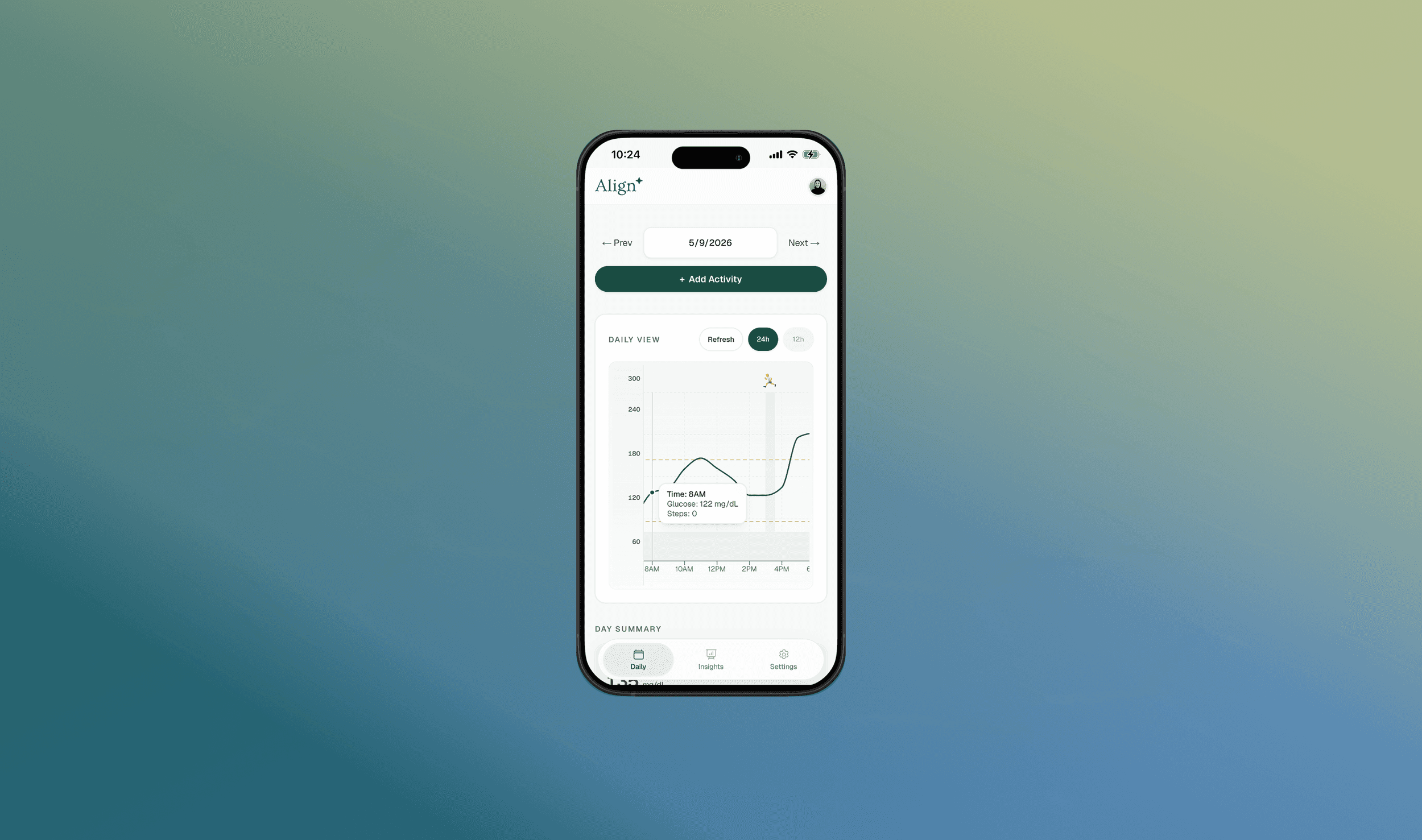
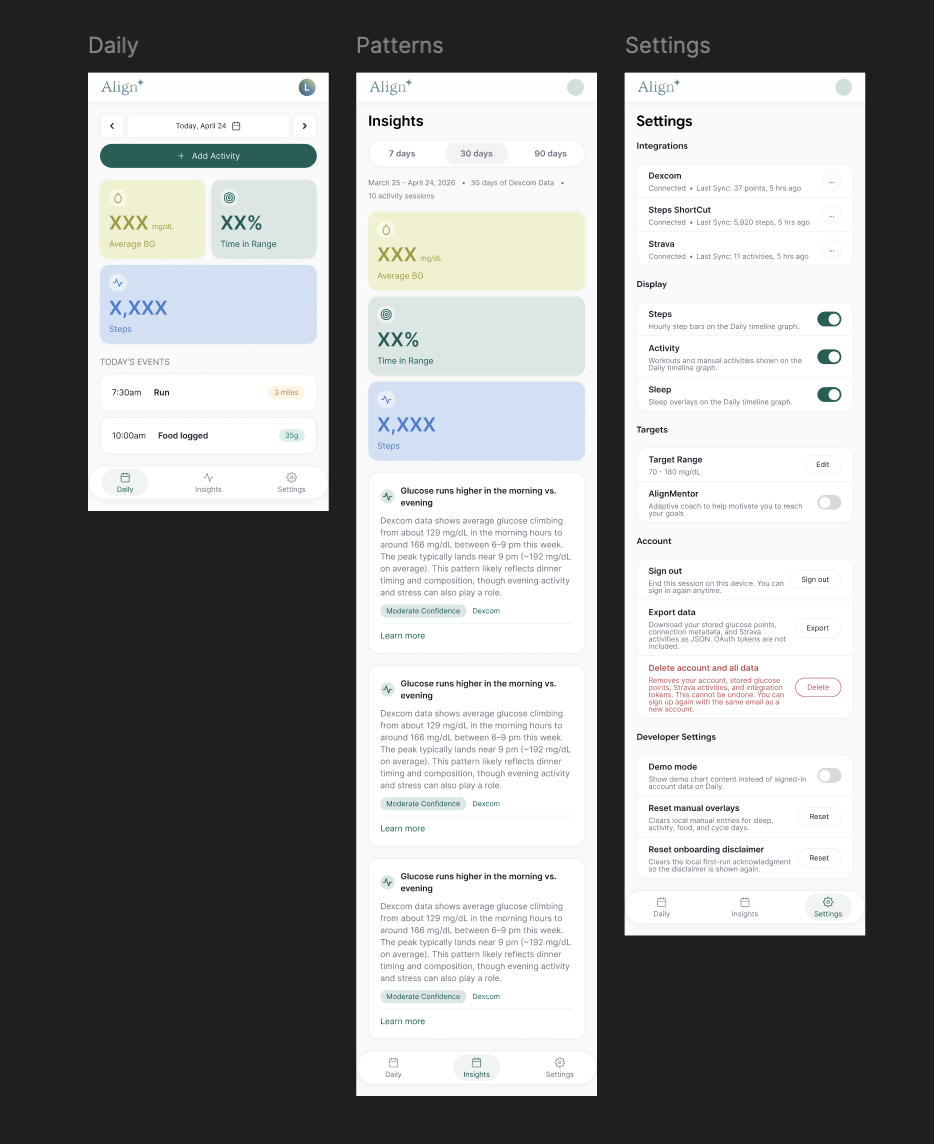
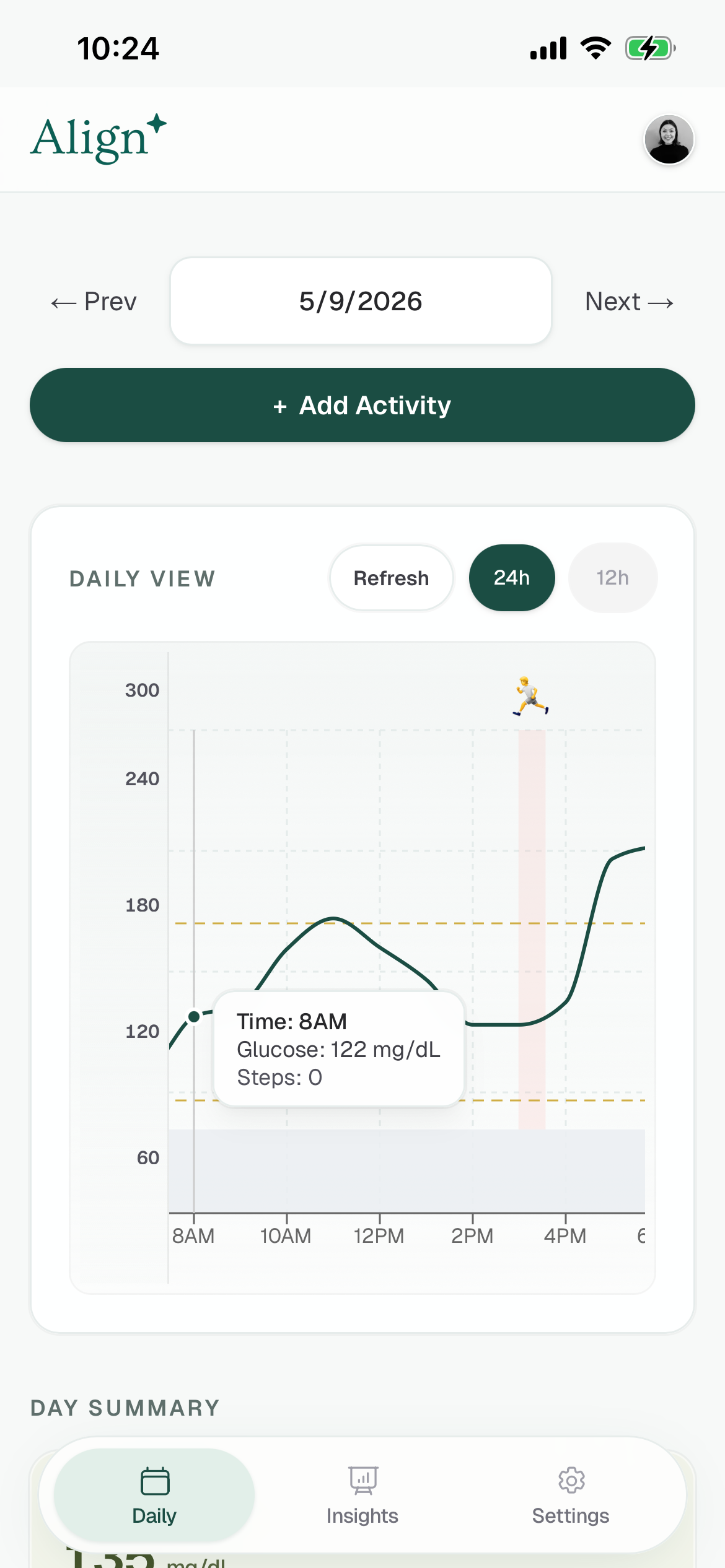
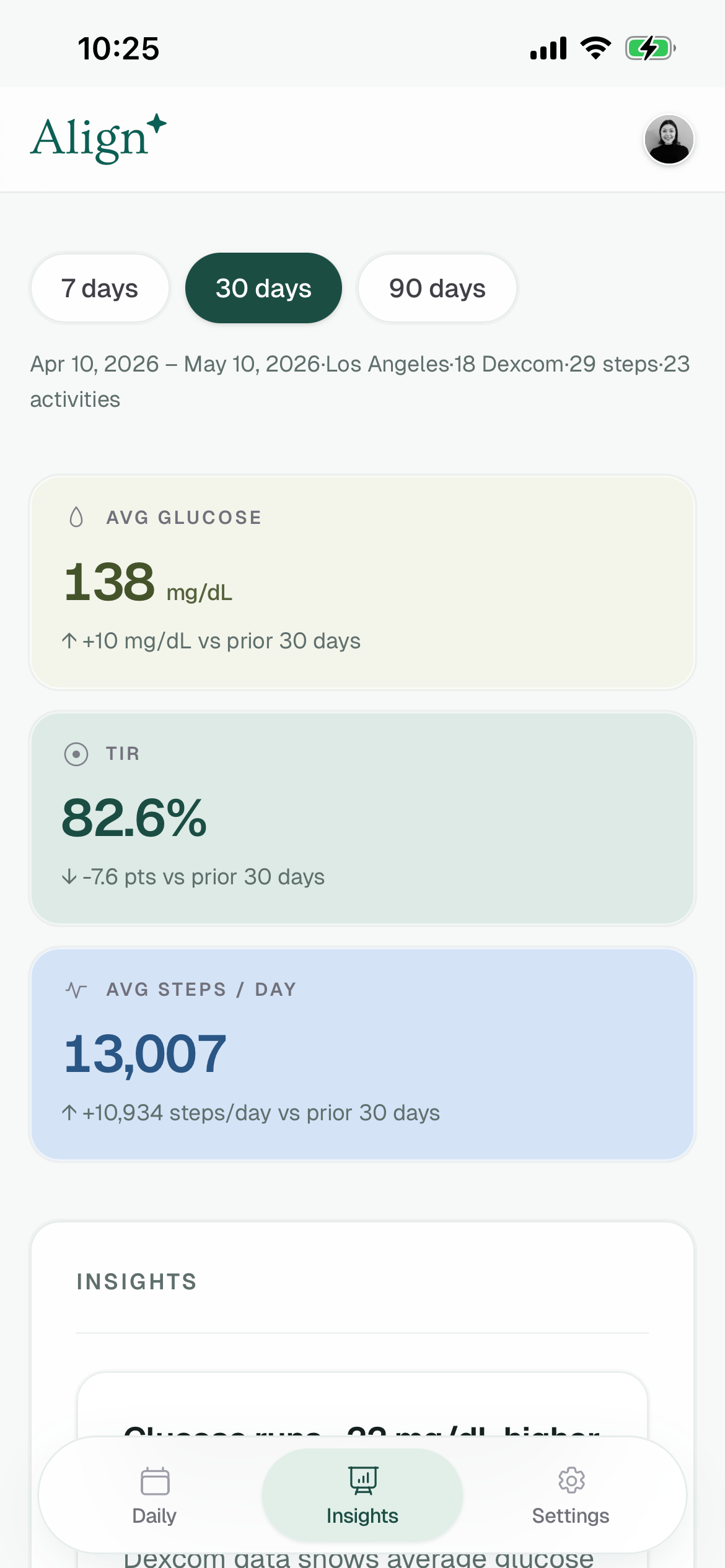
Align was designed around two core views: a Daily View that aligns glucose, activity, and movement into a single timeline, and an Insights View that surfaces recurring behavioral patterns over time.
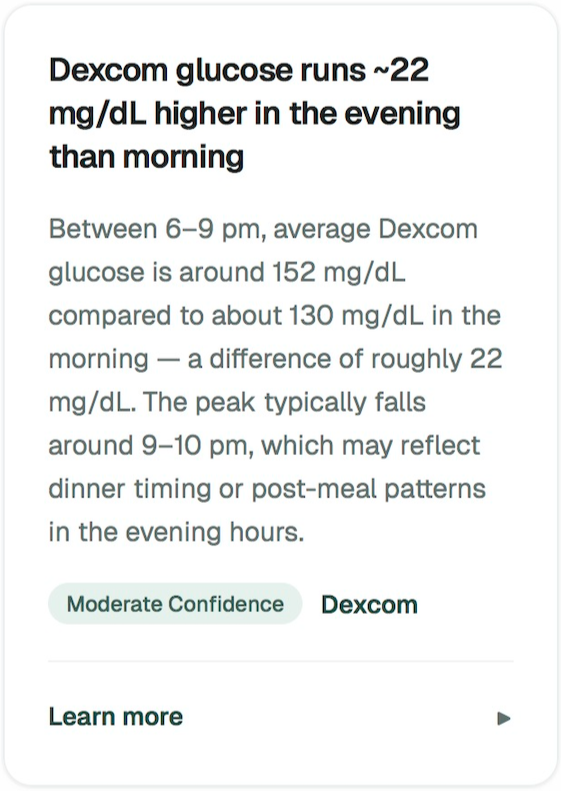
To keep insights explainable and safe, we used three predefined insight categories: Temporal Patterns (time of day / weekday-weekend), Session Patterns (glucose responses around workouts), and Movement Patterns (higher- vs lower-activity days).
Rather than allowing AI to freely interpret raw health data, Align first analyzed structured metrics across rolling 7-, 30-, and 90-day windows. Claude then translated validated patterns into clear summaries.
Each insight card included:
- a concise title
- a plain-language summary
- supporting evidence
- confidence indicators
- linked data sources
Safety Safeguards
- Predefined insight categories only
- No treatment or dosing recommendations
- Low-confidence patterns suppressed
- Confidence used for ranking, not clinical certainty
Product Design & Design System
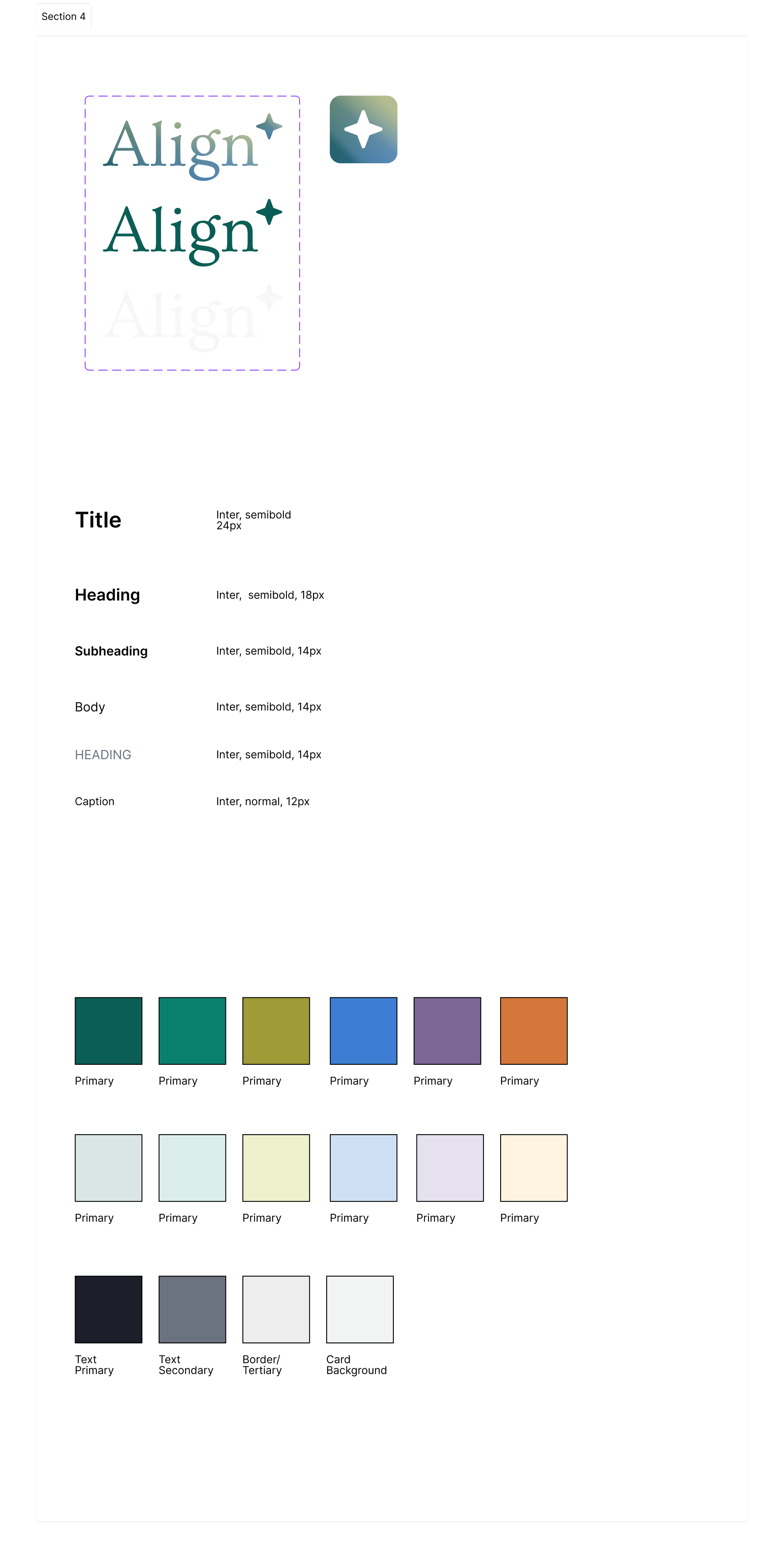
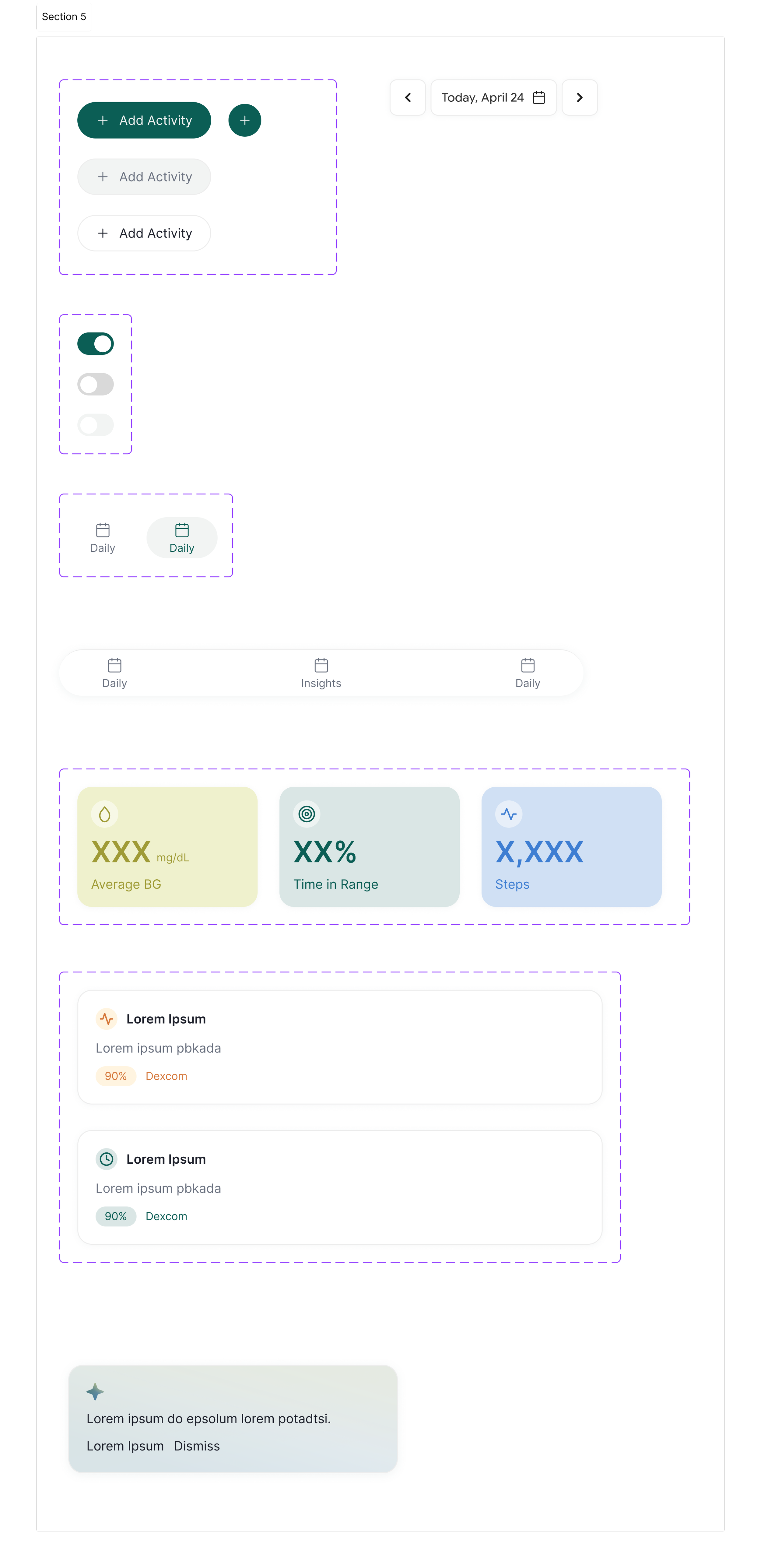
As the product architecture stabilized, I returned to Figma to build a lightweight design system that could scale with the product.
The system included:
- reusable cards and layout components
- typography and spacing standards
- notification and insight states
- color systems
A major design consideration throughout the process was ensuring the experience felt informative and trustworthy without feeling judgmental or overly clinical.
Final Product
Align evolved from a bootcamp concept into a functional responsive web application that integrates live glucose, activity, and movement data into a unified cross-device experience.
The current MVP includes connected health and activity integrations, AI-assisted behavioral insights, contextual timeline visualization, and pattern analysis across rolling time windows.
3
Health data sources unified
7–90d
Rolling analysis windows
v5
Iterations to stable architecture
Key Learnings & Next Steps
This project became an exploration of healthcare, AI-native product development, systems thinking, and contextual data visualization. Rather than replacing product thinking, AI amplified my ability to prototype quickly, explore ideas more independently, and bring complex concepts to life.
I’m continuing to evolve the platform with broader health integrations, more intuitive onboarding, improved syncing reliability, and more personalized insights. Long term, I’d love to expand Align into a dedicated mobile app focused on reducing the cognitive load of chronic disease management.